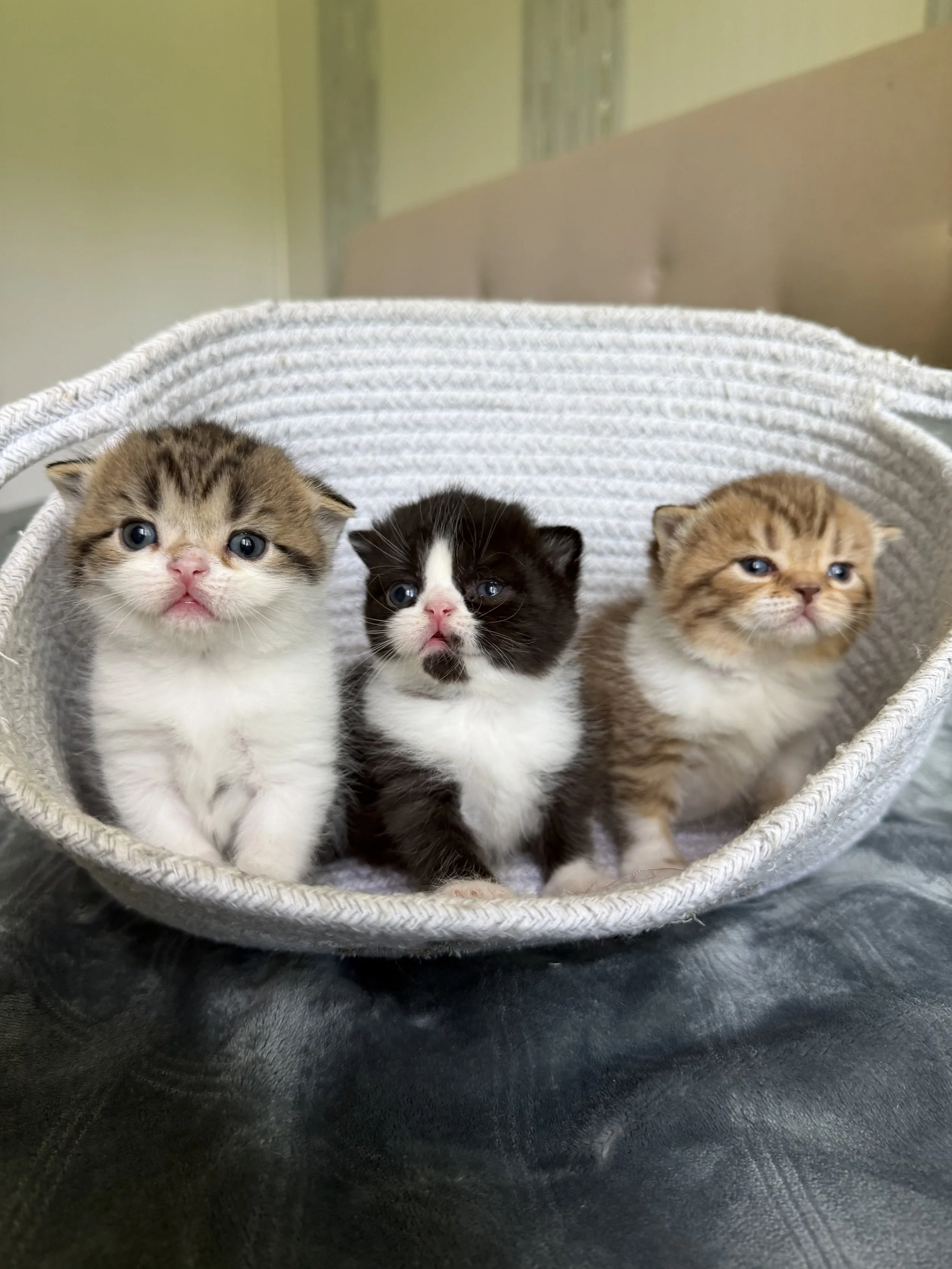
But what does bicolor actually mean?
If you have been looking at British Shorthair, Scottish Fold, or Scottish Straight kittens, you may have seen descriptions such as chocolate bicolor, black bicolor, blue bicolor, tabby bicolor, or golden tabby.
Cat color terminology can seem confusing at first, especially when several words are used to describe one kitten. The good news is that it becomes much easier once you understand that a kitten’s description may include several separate characteristics: color, pattern, and the presence or absence of white.
Here is a simple guide to understanding some of the beautiful colors and patterns found in British and Scottish cats.
What Does Bicolor Mean in Cats?
A bicolor cat has a colored coat combined with areas of white.
The colored portion might be black, blue, chocolate, cinnamon, or another color, while the white areas are typically seen on parts of the face, chest, belly, legs, or paws.
For example:
A black bicolor kitten has black and white fur.
A chocolate bicolor kitten has chocolate-colored and white fur.
A blue bicolor kitten has blue-gray and white fur.
The amount and placement of white can vary considerably from kitten to kitten. This is one reason two bicolor kittens of the same basic color can look surprisingly different.
Bicolor Is a Pattern, Not a Separate Breed
“Bicolor” does not mean that a cat is a particular breed.
British Shorthair, Scottish Fold, and Scottish Straight cats can all come in bicolor varieties.
A kitten can therefore be described as a:
British Shorthair chocolate bicolor
or a:
Scottish Fold black bicolor
The breed tells you what kind of cat the kitten is, while the rest of the description helps identify its coat.
What Is a Solid Color?
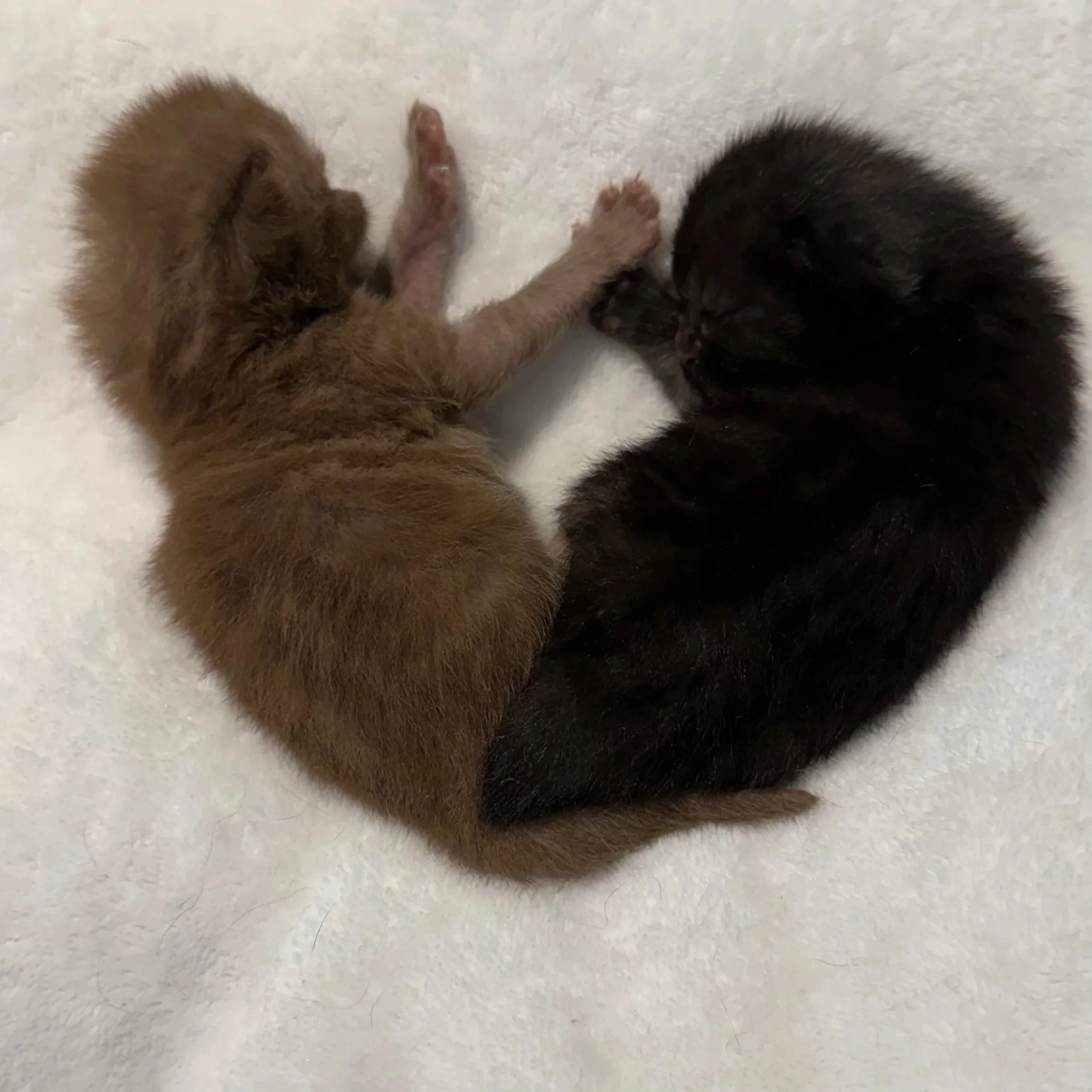
Solid black and chocolate Scottish Fold kittens with plush short coats and folded ears
A solid-colored cat has essentially one coat color without a tabby pattern or significant white spotting.
Common solid colors in British and Scottish cats can include:
Black — a deep black coat.
Blue — the familiar soft gray-blue color seen in many British Shorthairs.
Chocolate — a rich warm brown.
Cinnamon — a lighter, warmer reddish-brown tone.
The exact appearance of a color can vary depending on genetics, coat length, lighting, and the kitten's age.
What Does “Tabby” Mean?

Chocolate Bicolor Tabby
Tabby describes a coat pattern, rather than simply a color.
Tabby kittens have visible markings in their coats. Depending on the pattern, you may notice stripes, spots, swirls, or broader markings.
One of the easiest tabby features to recognize is the characteristic “M” marking on the forehead.
Common tabby patterns include:
Mackerel Tabby
A mackerel tabby typically has relatively narrow stripes running down the sides of the body.
The pattern is sometimes compared to a fish skeleton because of the way the stripes extend from the back toward the sides.
Classic Tabby
Classic tabbies have broader, swirling markings that can form beautiful circular or marble-like patterns along the sides.
This pattern is sometimes informally described as a marbled tabby.
Spotted Tabby
Instead of continuous stripes or swirls, the markings appear as spots across the body.
Can a Cat Be Both Tabby and Bicolor?
Yes!
This is one part of cat color terminology that initially confuses many families.
A kitten can have both a tabby pattern and white spotting.
For example, a kitten described as a brown tabby bicolor has colored tabby markings plus areas of white.
So “tabby” and “bicolor” are not necessarily competing descriptions. They can describe different features of the same coat.
What Does Golden Mean in British and Scottish Cats?
Golden British and Scottish cats are especially striking because their coats can have a warm golden or apricot appearance with darker pigmentation.
There are different golden coat patterns, so simply calling every golden-looking kitten a “golden cat” does not tell the whole story.
Depending on the kitten's genetics and pattern, you may encounter descriptions such as golden shaded or golden tabby.
Golden tabbies have clearly visible tabby markings, while shaded coats have a different distribution of darker pigmentation that creates their characteristic appearance.
A kitten's coat can also change considerably while growing. Young kittens may look darker, lighter, or more strongly patterned than they will as adults.
Chocolate, Cinnamon, Black and Blue
British and Scottish cats come in far more colors than the famous British blue many people immediately picture.
Black
Black kittens can have wonderfully dramatic coats, particularly when combined with white in a black bicolor.
Blue
In cat terminology, blue means gray.
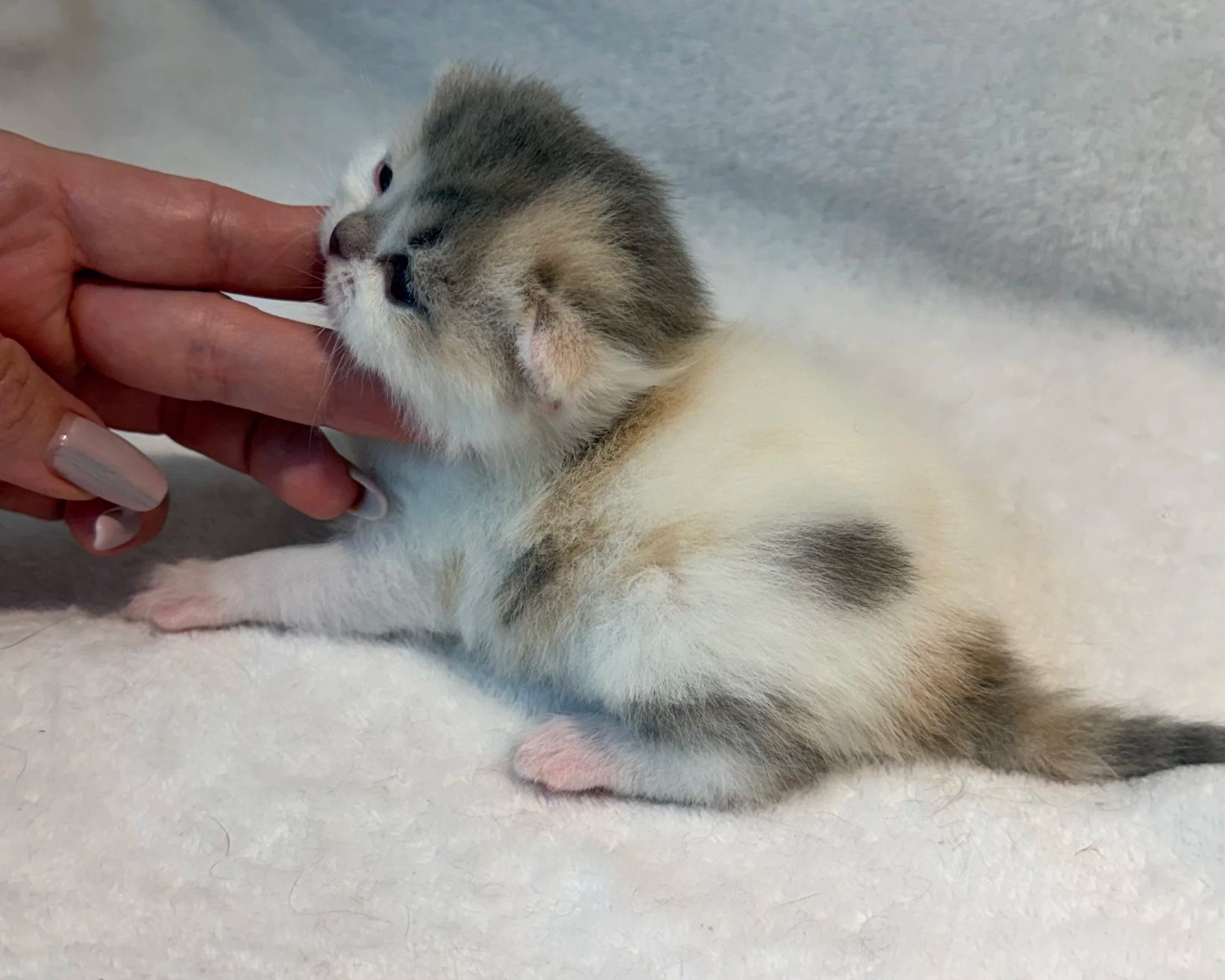
Blue-Cream Bicolor British Shorthair
It is a diluted version of black and is one of the best-known colors associated with the British Shorthair.
Chocolate
Chocolate is a warm brown color and can be particularly striking in British and Scottish kittens.
When white spotting is also present, the kitten may be described as a chocolate bicolor.
Cinnamon
Cinnamon is lighter and warmer than chocolate and can appear reddish or cinnamon-brown.
Chocolate and cinnamon can sometimes be difficult to distinguish from photographs alone, particularly in young kittens and under different lighting conditions.
Why Can a Kitten's Color Look Different in Photos?
If you are choosing a kitten from photographs or videos, don't be surprised if the coat looks slightly different from one image to another.
Several things can affect the way color appears:
Natural versus indoor lighting
Camera settings
Phone image processing
The kitten's age
Coat development
Seasonal coat changes
Background colors
Chocolate can look almost black in some photographs and noticeably brown in others. Golden kittens can also appear warmer or cooler depending on the lighting.
For this reason, a breeder's identification of the kitten's color and pedigree information can be more useful than judging color from a single photograph.
Do Coat Color and Pattern Affect Personality?
No particular coat color guarantees a particular personality.
A chocolate bicolor kitten is not inherently more affectionate than a blue kitten, and a golden tabby is not automatically more playful than a black bicolor.
Personality is influenced by many factors, including genetics beyond coat color, early socialization, environment, individual temperament, and experiences.
When choosing a kitten, we recommend considering temperament and compatibility with your family in addition to appearance.
The kitten you originally notice because of its beautiful color may catch your eye, but its personality is what you will live with and love for many years.
British Shorthair, Scottish Fold or Scottish Straight?
Color is only one part of choosing your future kitten.
British Shorthairs are known for their distinctive round appearance, dense coats, and generally calm demeanor.
Scottish cats include both Scottish Folds and Scottish Straights. Scottish Fold kittens develop folded ears when they inherit the Fold trait, while Scottish Straight kittens retain upright ears.
Importantly, Scottish Fold kittens are born with straight ears. The ears of kittens that inherit the Fold trait begin changing during the first few weeks of life.
Whether a Scottish kitten is Fold or Straight does not determine whether it can have a beautiful bicolor, tabby, solid, or other coat.
Every Kitten Is Unique
One of the most enjoyable parts of raising British and Scottish kittens is watching their appearance develop.
Two kittens from the same litter can inherit completely different combinations of color, pattern, white spotting, coat type, and other features.
Even two kittens described by the same color can look very different.
That is why we provide individual photographs, videos, and detailed information about our available kittens whenever possible.
Looking for a British or Scottish Kitten?
At BestOfTheBestKittens, we raise beautiful British and Scottish kittens in a variety of colors and patterns, which may include solid, bicolor, tabby, chocolate, black, golden, and other combinations depending on the litter.
If you are interested in a British Shorthair, Scottish Fold, or Scottish Straight kitten, visit our Available Kittens page to see current and upcoming litters.
And if you fall in love with a kitten but aren't quite sure what all the letters and color terminology mean, don't worry. We are happy to explain the kitten's color, pattern, coat, and breed.
Sometimes the technical description sounds complicated.
The kitten is still just adorable.
Helpful Cat Care & Breed Resources
ASPCA Cat Care
https://www.aspca.org/pet-care/cat-care
Helpful general resource for cat care, behavior, safety, nutrition, and responsible pet ownership.International Cat Care
https://icatcare.org/
Evidence-based information about feline health, behavior, nutrition, stress, and welfare.Cat Friendly Homes – American Association of Feline Practitioners
https://catfriendly.com/
Feline-focused veterinary information covering health, behavior, preventive care, and creating a cat-friendly home.Cornell Feline Health Center
https://www.vet.cornell.edu/departments-centers-and-institutes/cornell-feline-health-center/health-information
Veterinary-school resource covering feline health, diseases, behavior, nutrition, and general cat care.The International Cat Association (TICA) – Scottish Fold
https://tica.org/breed/scottish-fold/
Breed information about Scottish Fold and Scottish Straight cats, including appearance, temperament, coat, and breed characteristics.Cat Fanciers’ Association (CFA) – Scottish Fold
https://cfa.org/breed/scottish-fold/
Breed information and standards for Scottish Fold and Scottish Straight cats.Cat Fanciers’ Association (CFA) – British Shorthair
https://cfa.org/breed/british-shorthair/
Authoritative information about British Shorthair appearance, development, coat, colors, and breed characteristics.