When choosing between a British Shorthair, Scottish Fold, and Scottish Straight, families often focus first on the face, ears, color, or personality. But another important question is:
How big will my kitten get?
British and Scottish cats can look quite similar, especially as kittens, but there are differences in their typical build, adult weight, and how they mature. Both are relatively slow-developing cats, and that adorable round kitten may continue filling out for several years.
Here is a practical guide to what you can expect as your British or Scottish kitten grows.
British Shorthair Size and Weight
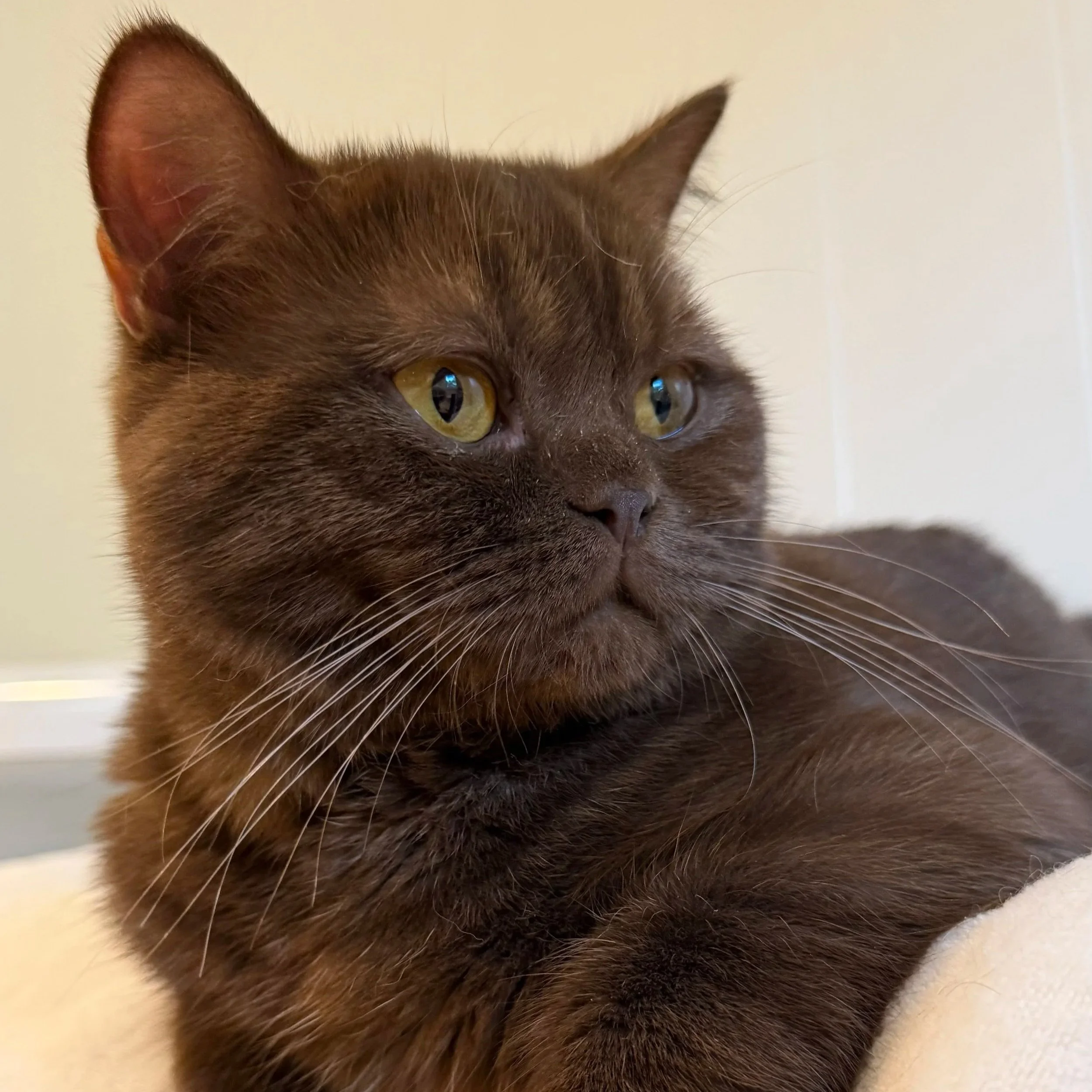
The British Shorthair is known for its substantial, powerful build.
Adult British Shorthairs typically have a broad chest, sturdy legs, a round head, full cheeks, and a dense coat that makes them appear even larger.
Males are generally noticeably larger and heavier than females.
Typical Adult British Shorthair Weight
A healthy adult may commonly fall around:
Males: approximately 9–17 pounds
Females: approximately 7–12 pounds
These are general ranges rather than ideal weights for every cat. Genetics, body frame, sex, neuter status, diet, and activity all influence adult size.
Some healthy British Shorthairs—particularly large-framed males—may fall outside these ranges.
The number on the scale is therefore less important than the cat's body condition and overall proportions.
Scottish Fold Size and Weight
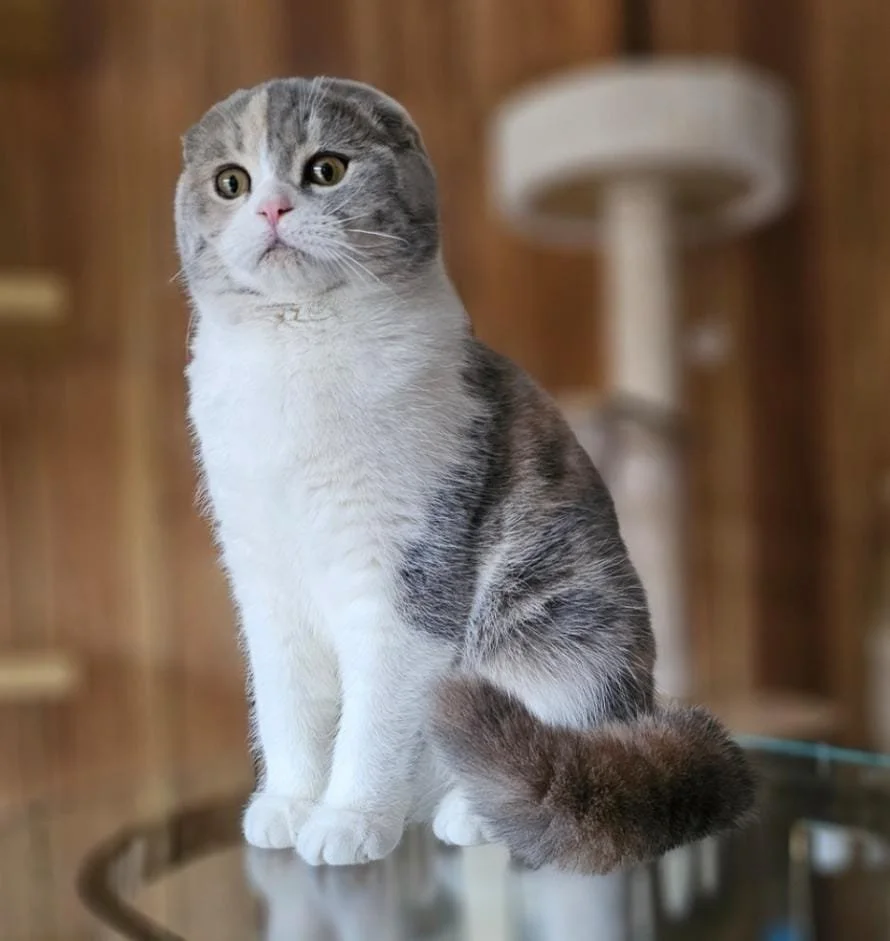
Scottish Folds are generally medium-sized cats with rounded features and a sturdy but often somewhat less massive build than the classic British Shorthair.
Typical adult weights are approximately:
Males: about 8–13 pounds
Females: about 6–9 pounds
Again, these are estimates rather than strict standards.
A Scottish Fold's adult size depends heavily on its individual genetics and breeding lines.
What About Scottish Straights?
This is where things can become confusing.
A Scottish Straight is not simply a British Shorthair with upright ears.
Scottish Folds and Scottish Straights belong to the Scottish breed group. The primary visible difference is that a Fold has folded ears while a Straight has upright ears.
Because British Shorthairs have historically been used in Scottish breeding programs, some Scottish Straights can have an extremely British-looking appearance: a round head, plush coat, substantial body and beautiful round eyes.
Their size can therefore overlap considerably with British Shorthairs.
Typical Scottish Straight adult weights often fall in a range similar to Scottish Folds:
Males: approximately 8–13 pounds
Females: approximately 6–10 pounds
Individual cats may be smaller or larger.
British Shorthair vs. Scottish: Which Is Bigger?
On average, the British Shorthair tends to be the heavier and more substantially built cat.
A mature British male can develop a particularly impressive appearance, with a broad chest, muscular body, thick neck and prominent cheeks.
Scottish cats generally have a somewhat lighter medium-sized build.
But there is significant overlap.
A large Scottish Straight male can easily be bigger than a petite British Shorthair female. Breed gives us a general expectation—it cannot predict an individual kitten's exact adult weight.
Why Does My British or Scottish Kitten Look So Small?
Because your kitten is still a kitten!
One of the biggest misconceptions among new owners is that a kitten approaching its first birthday should already look like a fully mature adult.
British and Scottish cats can continue developing well beyond their first year.
During growth, kittens often go through stages where their proportions temporarily change. A kitten may suddenly look:
Long-legged
Slim
Less round
All ears
Slightly awkward
Longer in the body
Then the chest broadens, the head develops, the coat changes, and the body begins filling out.
This is normal development.
When Is a British Shorthair Fully Grown?
British Shorthairs are known for slow maturation.
Although most of their skeletal growth occurs much earlier, they can continue filling out and developing their characteristic mature appearance for several years.
Many British Shorthairs don't reach their complete adult look until approximately 3–5 years of age.
This is particularly noticeable in males.
The broad head, cheeks, chest and muscular body associated with a mature British Shorthair don't appear overnight.
So if your one-year-old British Shorthair doesn't yet resemble the massive adult cats you've seen online, there may be absolutely nothing unusual about that.
When Are Scottish Cats Fully Grown?
Scottish Folds and Scottish Straights also mature gradually.
Much of their height and length develops during the first year, but their body can continue filling out afterward.
Many develop a more mature appearance during their second and third years.
Individual development varies considerably, particularly because different Scottish breeding lines can have different body types.
Male vs. Female: Does Sex Affect Size?
Yes, often significantly.
Male British and Scottish cats are generally larger than females of the same breed.
The difference isn't only weight.
Adult males often develop:
Broader heads
Fuller cheeks
Thicker necks
Larger frames
More muscular bodies
Females frequently have a more refined appearance and smaller frame.
That doesn't make one better than the other—it simply means that families wanting a particularly large, substantial-looking cat may naturally be attracted to males.
How Fast Should a Kitten Grow?
Kittens grow rapidly during their first months of life, but growth isn't perfectly linear.
They may experience periods of rapid growth followed by slower periods.
A kitten's growth depends on many factors, including:
Genetics
Sex
Nutrition
Litter size
Early development
Activity level
Overall health
Individual body frame
This is why comparing your kitten's weight with another kitten of exactly the same age isn't always useful.
Two perfectly healthy kittens can weigh different amounts and ultimately mature into very different-sized adults.
Can You Predict Adult Weight From a Kitten's Weight?
Only approximately.
A kitten with large parents and a substantial frame may be more likely to become a larger adult, but there is no simple formula that can accurately predict final weight.
Looking at the parents and bloodlines is often more informative than looking at one number on the scale.
Even littermates can mature differently.
One brother may become a large, broad adult while another remains smaller and more compact.
Bigger Doesn't Mean Healthier
A common mistake is assuming that an especially heavy British Shorthair must be an especially impressive example of the breed.
British Shorthairs are naturally substantial cats, but substantial is not the same as overweight.
Their dense coats can also make judging body condition visually more difficult.
A healthy British or Scottish cat should maintain an appropriate body condition rather than being encouraged to gain weight simply to achieve a particular number on the scale.
Extra body weight puts unnecessary stress on the body and does not improve breed type.
Why Does the Coat Make Such a Difference?
The British Shorthair's famously dense, plush coat adds considerably to its visual size.
A 10-pound British Shorthair may therefore look much more substantial than a 10-pound cat with a sleek coat.
Scottish cats can also have dense coats, and longhaired Scottish cats can appear particularly large because of their coat volume.
This is another reason photographs aren't a reliable way to estimate a cat's actual weight.
Longhair vs. Shorthair: Is One Bigger?
Not necessarily.
Longhair doesn't automatically mean a larger body.
A longhaired Scottish kitten may simply look larger because of the extra coat.
The same principle applies when comparing kittens of different coat densities.
To assess actual size, you need to look beneath the coat at the cat's frame and body condition.
Will Spaying or Neutering Affect Growth?
Spaying or neutering changes reproductive hormone activity and can also affect metabolism and energy needs.
It does not mean that a kitten will stop growing.
British and Scottish kittens continue developing according to their genetics and overall health after being spayed or neutered.
What owners do need to watch as their cats mature is calorie intake. An adult cat's nutritional requirements are different from those of a rapidly growing kitten.
Don't Choose a Kitten Based Only on Expected Size
Size can certainly be part of your preference.
Maybe you love the impressive, substantial appearance of an adult British Shorthair. Perhaps you prefer the somewhat lighter build of many Scottish cats.
But adult weight shouldn't be the deciding factor.
When choosing a kitten, consider:
temperament, health, personality, breed characteristics, coat maintenance and how well the individual kitten fits your family and lifestyle.
There is also no responsible way for a breeder to promise that a particular kitten will weigh exactly 10, 12 or 15 pounds as an adult.
We can provide information about the kitten's parents, current development and breeding lines—but every kitten is an individual.
British Shorthair, Scottish Fold or Scottish Straight?
All three can make wonderful companions for the right family.
If you love a particularly substantial, plush and powerful-looking adult cat, the British Shorthair may appeal to you.
If you love the characteristic folded ears of the Scottish Fold, that feature may capture your heart.
And if you love the Scottish temperament and round appearance but prefer upright ears, a Scottish Straight may be exactly what you're looking for.
Whichever you choose, remember that the tiny kitten you bring home is still developing.
Part of the fun is watching that little kitten gradually grow into the beautiful adult cat it was meant to become.
Looking for a British or Scottish Kitten?
At BestOfTheBestKittens, we raise beautiful British and Scottish kittens in a variety of colors and patterns, which may include solid, bicolor, tabby, chocolate, black, golden, and other combinations depending on the litter.
If you are interested in a British Shorthair, Scottish Fold, or Scottish Straight kitten, visit our Available Kittens page to see current and upcoming litters.
And if you fall in love with a kitten but aren't quite sure what all the letters and color terminology mean, don't worry. We are happy to explain the kitten's color, pattern, coat, and breed.
Sometimes the technical description sounds complicated.
The kitten is still just adorable.
Helpful Cat Care & Breed Resources
ASPCA Cat Care
https://www.aspca.org/pet-care/cat-care
Helpful general resource for cat care, behavior, safety, nutrition, and responsible pet ownership.International Cat Care
https://icatcare.org/
Evidence-based information about feline health, behavior, nutrition, stress, and welfare.Cat Friendly Homes – American Association of Feline Practitioners
https://catfriendly.com/
Feline-focused veterinary information covering health, behavior, preventive care, and creating a cat-friendly home.Cornell Feline Health Center
https://www.vet.cornell.edu/departments-centers-and-institutes/cornell-feline-health-center/health-information
Veterinary-school resource covering feline health, diseases, behavior, nutrition, and general cat care.The International Cat Association (TICA) – Scottish Fold
https://tica.org/breed/scottish-fold/
Breed information about Scottish Fold and Scottish Straight cats, including appearance, temperament, coat, and breed characteristics.Cat Fanciers’ Association (CFA) – Scottish Fold
https://cfa.org/breed/scottish-fold/
Breed information and standards for Scottish Fold and Scottish Straight cats.Cat Fanciers’ Association (CFA) – British Shorthair
https://cfa.org/breed/british-shorthair/
Authoritative information about British Shorthair appearance, development, coat, colors, and breed characteristics.